The Invisible Software Gap in Your Neighborhood
Did you know that nearly 65% of small service-based businesses still manage their entire daily workflow using a chaotic mix of paper notebooks, sticky notes, and basic Excel spreadsheets? It is a staggering reality that costs local entrepreneurs hours of productivity and thousands in lost revenue every single month. Here is the bold truth: these business owners do not need a complex enterprise solution like Salesforce or Oracle; they need a simple, custom tool that solves exactly one specific headache. I recently helped a local landscaping company replace their sun-faded paper scheduling books with a basic web application built in a single weekend, and they have been happily paying a $250 monthly subscription for that access ever since. You do not need to be a software engineer to bridge this gap; you just need to know how to connect the dots.
📹 Watch the video above to learn more!
What Exactly is a “Hyper-Niche” Micro-SaaS?
A Micro-SaaS (Software as a Service) is a digital product that targets a very specific, often overlooked market, usually managed by a solo founder. We are not talking about building the next Uber or Instagram here. Instead, think of a digital portal designed specifically for independent florists to track seasonal inventory, or a specialized dashboard for private music teachers to log student progress and lesson notes. The “Micro” part means the scope of the software is intentionally small and manageable. The “SaaS” part means the income is recurring, landing in your bank account every month like clockwork. By utilizing no-code platforms, you can build these fully functional tools without ever typing a single line of complex syntax or code.
Why the No-Code Revolution is Your Unfair Advantage
The best part? The barrier to entry has completely collapsed. In the past, building a subscription software required hiring a team of developers and spending $50,000 before you even saw a prototype. Today, visual development tools allow you to drag and drop elements to create professional-grade applications. Local businesses are desperate for these solutions because they are currently “too small” for big software companies to care about, yet they are “too big” to keep using pen and paper. When you provide a solution that saves a business owner five hours of administrative work a week, a $300 monthly fee is not an expense—it is an investment they are terrified to lose. This creates incredibly high retention rates and a predictable income stream that scales without increasing your workload.
How to Build Your First Micro-SaaS in 30 Days
You do not need a grand vision to start; you just need to find one person with a repetitive manual task. Follow these steps to go from zero to your first recurring payment.
Step 1: The “Excel Hell” Audit
Start by looking at the businesses you already interact with—your barber, your mechanic, or your local pet groomer. Ask them one simple question: “What part of your day involves the most manual data entry or repetitive texting?” You are looking for “Excel Hell,” where they are struggling to keep track of something that should be automated. Whether it is tracking equipment maintenance or managing client intake forms, the problem is your product’s foundation.
Step 2: Map the Logic, Not the Features
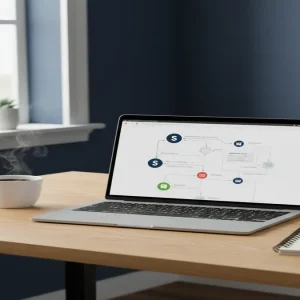
Resist the urge to build a dozen features. Most successful Micro-SaaS products do one thing exceptionally well. Use a tool like Whimsical or even a physical whiteboard to map out the user journey. If a client enters their name here, where should that data go? If a deadline is approaching, who needs to receive the notification? Once you have the logic flow, you have the blueprint for your application.
Step 3: Build the MVP on Bubble.io
Bubble is the gold standard for no-code web applications because it allows for complex logic and database management. Spend your first week watching basic tutorials and the second week building your Minimum Viable Product (MVP). Focus on a clean, mobile-responsive interface. Remember, your goal is utility, not artistic perfection. As long as the button triggers the right action and the data is saved correctly, you have a sellable product.
Step 4: The “Value-First” Beta Pitch
Do not try to “sell” your software in the traditional sense. Instead, approach your target business and offer them a 30-day free trial in exchange for honest feedback. Tell them, “I built this specifically to solve your scheduling problem, and I want to see if it actually saves you time.” Once they see their data organized and their manual tasks disappearing, they will not want to go back to the old way. This is when the trial converts into a paid subscription.
Step 5: Automate and White-Label
Once the first client is happy, you can “white-label” the solution. This means taking the same core app and selling it to other businesses in the same industry. If it works for one florist in your city, it will work for the 5,000 florists in the next state. Use Stripe for automated monthly billing so you never have to chase an invoice again.
Realistic Earnings and Growth Timelines
Let’s talk numbers because the math of Micro-SaaS is incredibly compelling. A typical niche app can easily command between $150 and $450 per month depending on the value it provides. If you land just five clients at $300 per month, you are looking at $1,500 in recurring revenue. Because your overhead is minimal—usually just the $32/month Bubble subscription and a few API costs—your profit margins often exceed 90%. Most beginners can reach their first $1,000/month within 60 to 90 days if they stay focused on one specific niche rather than trying to build a general tool for everyone.
Your Essential No-Code Toolkit
- Bubble.io: The core engine for building your web application and database.
- Stripe: For handling all recurring subscriptions and secure payments.
- Loom: To create quick video tutorials showing your clients how to use the app.
- Tally.so: For creating beautiful intake forms that feed data directly into your software.
- Canva: To design a professional-looking logo and basic UI elements.
Common Pitfalls to Avoid
The most common mistake is “Feature Creep.” You might feel the urge to add more and more buttons, but this usually just confuses the user and delays your launch. Keep it simple. Secondly, do not build in a vacuum. If you spend three months building something without talking to a potential customer, you will likely build something nobody wants. Finally, do not ignore mobile responsiveness. Most local business owners are on the move and will want to check your app from their phones, not just a desktop.
Your Next Move
The gap between manual labor and digital efficiency is where the most consistent online income is made today. You do not need to be a genius; you just need to be a problem solver. Your immediate next step is to call one local business owner this week and ask them what their most annoying spreadsheet task is. Stop dreaming about the next big tech unicorn and start building the small tool that a local business can’t live without.