The Unsexy Truth About Digital Wealth
You don’t need to be a Silicon Valley engineer with a computer science degree to build software that pays your mortgage every single month. In fact, the most profitable software products in 2024 aren’t the next viral social networks; they are simple, “boring” tools that fix specific headaches for local service businesses like plumbers, electricians, and landscapers. While everyone else is fighting for pennies in saturated affiliate markets, I’ve been quietly building a portfolio of micro-SaaS tools that generate consistent, recurring revenue without writing a single line of code.
📹 Watch the video above to learn more!
Have you ever noticed how your local plumber still uses a paper notebook or a messy Excel sheet to track their service calls? That’s not just an old-school habit; it’s a massive leak in their business efficiency that they are willing to pay cold, hard cash to fix. By positioning yourself as the person who provides the digital solution to that specific leak, you transition from a gig-worker to a software owner. The best part? You can build these solutions in a weekend using drag-and-drop tools that are as easy to use as Canva or PowerPoint.
What Exactly is a No-Code Micro-SaaS?
A Micro-SaaS (Software as a Service) is a cloud-based tool that solves a very specific problem for a very specific niche. Unlike massive platforms like Salesforce or HubSpot, a Micro-SaaS doesn’t try to do everything for everyone. Instead, it might just do one thing—like automated SMS appointment reminders for dog groomers—and do it exceptionally well. Because the scope is so small, you don’t need a team of developers to build it.
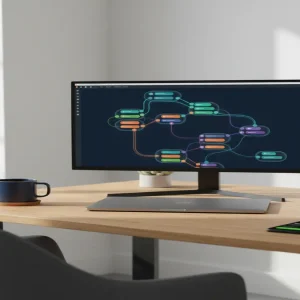
No-code platforms like Bubble.io, Glide, and Softr have democratized the software industry. These platforms allow you to build functional web and mobile applications by simply connecting blocks of logic and designing the interface visually. You aren’t coding; you’re orchestrating. When you combine the power of no-code with a “boring” local industry, you create a high-margin digital asset that businesses keep paying for year after year because it becomes essential to their daily operations.
Why This Method Beats Every Other Side Hustle
Most online income streams require you to constantly trade your time for money or chase the latest algorithm change. If you’re a freelancer, you stop getting paid the moment you stop working. If you’re a YouTuber, your income can vanish if the algorithm stops favoring your niche. Micro-SaaS is different because it is built on recurring subscription revenue. Once the tool is built and the client is onboarded, the work is largely done, yet the checks keep coming in every 30 days.
Furthermore, local businesses have high “stickiness.” Once a plumber has all their customer data and scheduling history inside your app, they are very unlikely to cancel their $150 or $250 monthly subscription. It’s a small price for them to pay for a tool that saves them five hours of admin work a week. You aren’t selling a luxury; you’re selling an efficiency engine that pays for itself. This creates a level of financial stability that most digital entrepreneurs only dream of.
How to Build Your First Micro-SaaS in 5 Steps
-
The Deep Dive Niche Audit
Stop looking for “big ideas” and start looking for “annoying problems.” Call three local service businesses—landscapers, HVAC technicians, or even private tutors. Ask them, “What is the one task you do every day that you absolutely hate doing manually?” Usually, it’s something related to scheduling, invoicing, or collecting customer reviews. This is your product roadmap. Don’t build until you’ve identified a recurring pain point that costs them time or money.
-
The Frictionless Build with Glide or Bubble
Once you have the problem, choose your tool. If you need a simple mobile-first app, Glide Apps is your best friend because it turns a Google Sheet into an app in minutes. If you need a more robust web platform with complex logic, Bubble.io is the gold standard. Focus on the “Minimum Viable Product” (MVP). If the problem is scheduling, your app should only do scheduling. Resist the urge to add bells and whistles that distract from the core solution.
-
The Beta-Test Bridge
Don’t try to sell your app immediately. Instead, approach one local business owner and offer them the tool for free for 30 days in exchange for their honest feedback. This “Beta-Test” period is crucial because it allows you to find bugs and prove the value of the software. When they see their business running smoother, the transition to a paid subscription at the end of the month becomes a no-brainer for them.
-
The Automated Subscription Handshake
Set up your payment processing using Stripe. You want to ensure that your income is truly passive. Avoid manual invoicing at all costs. Set up a recurring billing cycle where the client’s card is charged automatically on the 1st of every month. This professionalizes your business and ensures you aren’t chasing down checks like a traditional contractor would.
-
The Referral Flywheel
Once you have one happy plumber, ask them for an intro to their peers in the next town over. Local business owners talk to each other. Because your software is niche-specific, your first client becomes your best salesperson. You don’t need 1,000 customers to make a full-time living; you only need 20 to 30 clients paying $200 a month to hit that $4,000-$6,000 monthly target.
Realistic Earnings and Timelines
Let’s talk numbers because that’s what matters. A typical micro-SaaS for a local business can easily be priced between $100 and $300 per month. If you spend your first month researching and building, and your second month landing your first three beta testers, you could realistically earn your first dollar by day 60. By the end of month six, with a dedicated outreach strategy, hitting 15-20 clients is a very achievable goal. That puts your monthly recurring revenue (MRR) between $3,000 and $6,000 with nearly 90% profit margins.
Required Tools and Resources
- Bubble.io or Glide: The engine used to build your application without code.
- Stripe: For handling recurring monthly subscriptions and payouts.
- Loom: To record short video demos of your app to send to potential clients.
- Google Sheets: Often used as the simple database backend for no-code apps.
Common Mistakes to Avoid
1. Falling into the Feature Trap
The biggest mistake beginners make is trying to build a “complete” software suite. Your clients don’t want more features; they want their one specific problem to go away. Keep it simple, keep it fast, and keep it focused on one result.
2. Ignoring Customer Support
Even though it’s no-code, things can occasionally break. If a business owner relies on your tool to run their day, you need to be responsive. Set up a simple support email and check it daily to maintain the trust that keeps those subscriptions active.
3. Targeting Low-Value Niches
Don’t build for businesses that don’t have money. A hobbyist blogger might struggle to pay $20/month, but a roofing company doing $500k in annual revenue won’t blink at $250/month if your tool helps them close just one extra lead.
Your Next Step Toward Software Ownership
The barrier to entry in the software world has never been lower, yet the demand for specific, local digital solutions has never been higher. You have a choice: you can continue looking for the next “hack,” or you can build a real digital asset that provides genuine value to a local business owner. Your immediate next step? Go to Google Maps, find five local service businesses in your area with 3-star reviews, and look for the common complaints—that is where your first $2,000/month app idea is hiding.