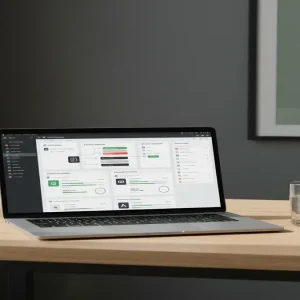
The Hidden $4,800 Monthly Revenue Stream Hiding in Your Google Drive
Most people treat Google Sheets as a digital filing cabinet for boring data, but I recently watched a creator generate $4,820 in just 28 days by treating it as a software engine. You’ve likely heard that building a SaaS (Software as a Service) is the path to wealth, but the secret that high-level digital entrepreneurs aren’t telling you is that you don’t need a standalone app to make recurring bank. While everyone else is struggling with complex code and expensive hosting, a small group of insiders is quietly selling ‘intelligent’ spreadsheets that do the heavy lifting for small businesses. It’s called Spreadsheet-as-a-Service, and it’s the most underrated digital asset in 2024.
📹 Watch the video above to learn more!
Here’s the thing: businesses don’t actually want more software subscriptions to manage; they want solutions to their specific problems. When you add a single line of script to a standard Google Sheet that connects it to the OpenAI API, you transform a boring grid into a powerful automation tool. You aren’t just selling a file; you’re selling a workflow that saves a business owner ten hours a week. Whether it’s a real estate agent who needs to score 500 leads in seconds or an e-commerce brand that needs 1,000 product descriptions written overnight, the spreadsheet is the ‘Trojan Horse’ of AI implementation.
Why Intelligent Spreadsheets Outperform Traditional Apps
Why would a savvy business owner pay $150 for a Google Sheet when they could just use ChatGPT for free? The answer lies in friction and structure. Most people are intimidated by a blank AI prompt box. They don’t know how to engineer prompts, and they certainly don’t have the patience to copy-paste data back and forth between tabs. By packaging your expertise into a pre-configured Google Sheet, you provide a familiar environment where they can process data in bulk without learning a new interface. It’s the ultimate low-friction solution.
The best part? Google Sheets is essentially free to host. You don’t have to worry about server crashes, database management, or complex security protocols. Google handles the infrastructure, while you focus purely on the logic and the value. Because the data lives in the customer’s own Google Drive, they feel a sense of ownership and security that they don’t get with third-party apps. This trust translates directly into higher conversion rates and premium pricing for your templates.
Step 1: Identify a High-Value Data Problem
Your first step is to find a niche where people are drowning in repetitive manual tasks. Don’t build a ‘general’ AI sheet; build a ‘Real Estate Lead Scorer’ or a ‘YouTube Script Generator for Tech Reviewers.’ Specificity is your greatest asset here. Look for industries that handle large volumes of text or data—think HR departments reviewing resumes, SEO agencies auditing metadata, or local service businesses managing customer reviews. Your goal is to find a task that currently takes a human hours but could take AI seconds.
Step 2: Design the Logic and Interface
Open a new Google Sheet and map out exactly how the data should flow. Use one tab for ‘Input,’ one for ‘Processing,’ and one for ‘Output.’ This keeps the user experience clean. You want your customers to feel like they are using a professional tool, not a messy scratchpad. Use custom cell colors, bold headers, and clear instructions. I recommend using a sage green and charcoal color palette to give it a modern, tech-focused aesthetic that justifies a premium price tag.
Step 3: Connect the AI Secret Sauce
This is where the magic happens. You’ll use Google Apps Script—a simple, JavaScript-based language—to connect your sheet to the OpenAI API. Don’t worry if you aren’t a coder; you can actually ask ChatGPT to write the script for you. The script will take the text from a specific cell, send it to OpenAI with a pre-written prompt you’ve designed, and return the result back into your sheet. Once this is set up, your spreadsheet can suddenly ‘think’ and ‘write’ just like a human would, but at lightning speed.
Step 4: Protect and Package Your Asset
Before you sell your creation, you need to ensure your hard work is protected. Use the ‘Protect Sheet’ feature to lock your formulas and scripts so users can’t accidentally break the automation. You should also include a dedicated ‘Setup’ tab where the user enters their own OpenAI API key. This is crucial because it means they pay for the AI usage, not you. This keeps your profit margins at nearly 100% since you have no ongoing costs after the initial build.
Step 5: Launch on Niche Marketplaces
Don’t just post a link on social media and hope for the best. List your product on specialized marketplaces like Gumroad, Etsy, or AppSumo. Create a compelling demo video using a tool like Loom to show the spreadsheet in action. When people see 50 rows of data being processed automatically with the click of a button, the value proposition becomes undeniable. Start with a ‘Founder’s Price’ of $49 to get your first 10 reviews, then quickly scale up to $150 or more as you build social proof.
Realistic Earnings and Timeline
Let’s talk numbers. This isn’t a ‘get rich overnight’ scheme, but it is a highly scalable micro-business. A well-designed, niche-specific AI spreadsheet typically sells for between $97 and $197. If you sell just one template a day at $150, you’re looking at $4,500 per month in passive income. The initial investment is roughly 10-20 hours of your time and $0 in capital. Most creators see their first sale within 7 to 10 days of listing on a marketplace like Gumroad, provided they have targeted a specific pain point.
Essential Tools for Your Spreadsheet Business
- Google Sheets: Your primary development platform and host.
- OpenAI API: The engine that provides the intelligence for your templates.
- Google Apps Script: The bridge between the sheet and the AI.
- Gumroad: For payment processing and digital file delivery.
- Loom: To record high-converting video demonstrations.
Common Pitfalls to Avoid
- Hardcoding Your API Key: Never leave your own API key in the script. Always make the user provide their own key in a designated cell.
- Overcomplicating the UI: If a user has to read a 20-page manual to use your sheet, they will ask for a refund. Keep it ‘one-click’ simple.
- Ignoring Mobile Users: While most work happens on desktop, ensure your sheet doesn’t break if someone opens it on the Google Sheets mobile app.
- Broad Targeting: A ‘General AI Assistant’ sheet will fail. A ‘Sheet for Amazon FBA Product Research’ will fly off the virtual shelves.
Ready to Build Your First Digital Asset?
The window for ‘Spreadsheet-as-a-Service’ is wide open right now because most people still don’t realize how powerful Google Apps Script has become when paired with AI. You don’t need to be a software engineer to build a high-value tool that businesses will happily pay for. You just need to find one repetitive problem and solve it once inside a grid. Your next step is simple: Open a new Google Sheet right now and list five repetitive tasks you’ve done this week that AI could have handled for you. That list is your roadmap to your first $1,000 month.