The Secret Search Engine Most People Treat Like Social Media
Did you know that 89% of people on Pinterest are there specifically to plan for future purchases? While everyone else is fighting for 3 seconds of attention on TikTok, a small group of savvy creators is building “Aesthetic Engines” that generate thousands in passive affiliate commissions. I’m not talking about posting selfies or dancing; I’m talking about curated visual systems that work while you sleep.
📹 Watch the video above to learn more!
If you’ve ever felt like you’re shouting into the void on Instagram, it’s because those platforms are designed for the moment. Pinterest is different because it’s a visual search engine, not a social network. A single pin you create today can continue to drive traffic and sales for two, three, or even five years. Let’s dive into how you can harness this longevity to build a recurring income stream without ever showing your face.
What Exactly is a Pinterest Aesthetic Engine?
An Aesthetic Engine is a highly optimized Pinterest Business account that focuses on a specific, high-intent visual niche. Instead of posting random content, you create a cohesive “vibe” that attracts users looking for inspiration in areas like home decor, luxury travel, or minimalist tech setups. You aren’t just a pinner; you’re a digital curator who connects people with the products they already want to buy.
The magic happens when you pair high-quality, AI-generated or curated imagery with strategic affiliate links. By using a “Bridge Page” or a specialized storefront like LTK (LikeToKnowIt), you create a seamless shopping experience for the user. It’s a low-friction way to earn commissions because you are providing the exact solution to their search query at the peak of their buying intent.
Why This Method Outperforms Traditional Freelancing
The biggest problem with freelancing is that if you stop working, the money stops flowing. With the Pinterest Aesthetic Engine, you are building a digital asset. Every pin is a digital salesperson that works 24/7 across every time zone. Because Pinterest rewards “freshness” and SEO over follower counts, a brand-new account can see viral traffic within weeks, not years.
The scalability is virtually limitless. Once you master the workflow for one niche, you can replicate the system across five or ten different accounts. You aren’t trading your time for an hourly rate; you’re investing your time into a machine that compounds over time. Plus, because you’re using AI tools to generate the visuals, your overhead is almost zero.
The Psychology of the Visual Searcher
People use Pinterest to escape their current reality and plan their dream one. When you provide the visual blueprint for that dream—whether it’s a “Scandi-Boho Living Room” or a “Cyberpunk Desktop Setup”—you become the trusted guide. They aren’t clicking an ad; they are clicking a recommendation that fits perfectly into their vision board. This shift in psychology is why Pinterest traffic often converts at a much higher rate than Facebook or X (formerly Twitter).
How to Build Your Engine in 5 Strategic Steps
Building this isn’t about luck; it’s about following a specific data-driven sequence. If you skip a step, the engine stalls. If you follow them, the momentum becomes unstoppable. Here is exactly how to set up your first engine from scratch.
Step 1: Identify Your High-AOV Niche
AOV stands for Average Order Value. You don’t want to promote $5 stickers; you want to promote $500 coffee machines or $1,200 sofas. Look for niches where people are already spending significant money and where the aesthetic is the primary selling point. Home organization, sustainable fashion, and outdoor gear are perennial goldmines. Use the Pinterest Trends tool to see what’s spiking before you commit.
Step 2: Generate High-Fidelity Visuals with Midjourney
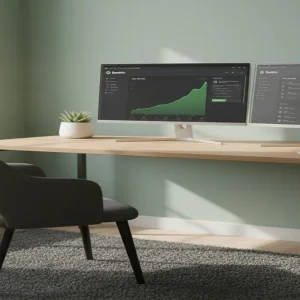
The secret to standing out is original, high-quality imagery. Use an AI tool like Midjourney to create “lifestyle” photos that look like they belong in a high-end magazine. For example, instead of using a boring stock photo of a desk, prompt the AI for a “Minimalist oak desk with soft morning sunlight, cinematic lighting, 8k resolution, architectural digest style.” These visuals stop the scroll and earn the click.
Step 3: The SEO Layering Process
Every pin needs a title, description, and alt-text loaded with long-tail keywords. Don’t just name a pin “Cool Kitchen.” Use a title like “Modern Sage Green Kitchen Design Ideas for Small Apartments.” This tells the Pinterest algorithm exactly who to show your pin to. Think like a searcher: what exact words would they type into the search bar to find your image?
Step 4: Set Up Your Bridge Page
Never link directly from Pinterest to an Amazon product page; Pinterest often flags this as spam. Instead, use a tool like Koji or Beacons to create a beautiful mobile-optimized landing page. This page should feature the products from your pins clearly. This extra step protects your account and allows you to capture email addresses, which is another income stream in itself.
Step 5: Automate with Tailwind
You shouldn’t be manually pinning every day. Use Tailwind to schedule your content for the next 30 days in one sitting. Use their “SmartLoop” feature to re-share your best-performing pins at optimal times. This is how you turn a side hustle into a passive engine. You spend 4 hours a month on content creation, and the automation handles the rest.
Realistic Earnings: What Can You Actually Expect?
Let’s talk numbers because transparency is key. You won’t make $4,000 in your first week. This is a 90-day build. Typically, in month one, you’ll see a lot of impressions but maybe only $10–$50 in commissions as the algorithm learns your niche. By month three, once you have 500+ pins circulating, you can expect to see $500–$1,000 monthly.
The $4,200 mark usually happens around month six to eight, once your pins start ranking in Google Image search as well as Pinterest search. At this stage, your traffic becomes a self-sustaining flywheel. One of my students reached $3,800 in month seven by focusing exclusively on the “Luxury Van Life” niche, selling solar power kits and high-end camping gear via affiliate links.
Your Essential Tool Kit
- Midjourney: For creating unique, high-converting aesthetic images ($10/mo).
- Canva Pro: For adding text overlays and creating “Idea Pin” templates.
- Tailwind: For scheduling and automated looping ($15/mo).
- Pinterest Business Account: Free (but essential for analytics).
- Affiliate Networks: Amazon Associates, LTK, or Impact Radius.
Common Pitfalls to Avoid
1. Quantity Over Quality
Pinterest used to be a numbers game, but now it’s a quality game. Posting 50 low-quality pins a day will get your account shadowbanned. Focus on 3–5 high-quality, original pins that actually provide value or inspiration to the user.
2. Ignoring the Mobile Experience
Over 80% of Pinterest users are on the mobile app. If your bridge page takes more than 2 seconds to load or looks messy on a smartphone, you are flushing money down the toilet. Always test your links on your own phone first.
3. Forgetting the ‘Fresh Pin’ Rule
Pinterest prioritizes new images. Don’t just repin the same image to ten different boards. Change the background, the font, or the crop for every board you post to. This signals to the algorithm that you are providing fresh content for their users.
Final Thoughts: Your Next Step
The Pinterest Aesthetic Engine is one of the few remaining online business models where a beginner can compete with big brands simply by having better taste and better SEO. It requires no face-to-camera video, no customer service, and no inventory management. It is the ultimate expression of the “build once, sell forever” philosophy.
Your immediate next step: Go to the Pinterest Trends tool right now and search for three niches you’re interested in. If the graph is moving upward, that is your signal to start your first board today.