The Era of Generic Productivity is Dead
The digital gold rush for generic ‘productivity planners’ ended in 2022, but a new, more lucrative frontier has emerged that most creators are completely overlooking: the Micro-OS. While thousands of beginners are struggling to sell $10 ‘Daily Journals’ on Etsy, a small group of insiders is quietly generating $6,000 or more every month by building hyper-specific ‘Operating Systems’ for niche professionals. Here is the reality: a real estate agent doesn’t want a ‘planner’; they want a system that tracks lead sources, manages escrow dates, and automates follow-ups in one click. When you stop selling templates and start selling solutions, your income potential shifts from pocket change to a full-time salary.
📹 Watch the video above to learn more!
What Exactly is a Micro-OS?
A Micro-OS is a comprehensive, pre-configured digital workspace built on a platform like Notion that serves as the ‘brain’ for a specific type of business or professional. Unlike a simple template, which might just be a pretty page with some checkboxes, a Micro-OS utilizes complex relational databases, automated formulas, and interconnected dashboards. Think of it as ‘software-as-a-service’ (SaaS) but without the need to write a single line of code. You are essentially building a custom software solution using Notion’s building blocks, then licensing that solution to hundreds of people who have the same problem. It is the ultimate bridge between low-cost digital downloads and high-ticket consulting.
Why Niche Specificity is Your Secret Weapon
The secret to the Micro-OS strategy lies in the ‘Niche-Depth’ advantage. When you target everyone, you appeal to no one. However, when you build a system specifically for independent Speech Therapists or Specialty Coffee Roasters, you eliminate 99% of your competition instantly.
High Perceived Value
A generic ‘Business Tracker’ is worth $20 to most people. A ‘Clinical Practice OS for Psychologists’ that handles HIPAA-compliant-style notes and session tracking can easily command $150 to $300 per license. The user isn’t buying a document; they are buying back their time and reducing their mental load.
Low Friction Marketing
It is significantly easier to find and market to a specific group. You don’t need a massive social media following; you just need to show up in the specific subreddits, Facebook groups, or Discord servers where these professionals hang out. Your marketing becomes a conversation about solving their specific, annoying daily tasks.
The 5-Step Blueprint to Your First $2,000 Sale
Building a Micro-OS requires more thought than a standard digital product, but the payoff is exponentially higher. Follow this exact sequence to go from zero to your first paying customer in less than 30 days.
- Identify the ‘High-Value/Low-Tech’ Demographic: Look for professions that involve a lot of moving parts but aren’t traditionally ‘tech-heavy.’ Think of interior designers, boutique gym owners, or freelance paralegals. These people are currently drowning in spreadsheets and sticky notes. They have the budget to solve the problem but lack the time to build the solution themselves.
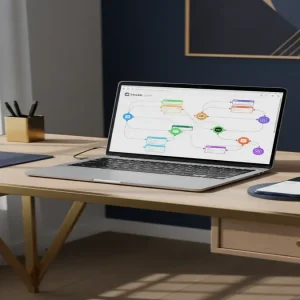
- Map the Workflow Architecture: Before you open Notion, grab a piece of paper. Map out every step of your target user’s day. What is the first thing they check? Where do they lose data? If you’re building for a Wedding Photographer, you need to map the journey from ‘Initial Inquiry’ to ‘Gallery Delivery.’ Your OS must house every one of these steps in a logical, interconnected flow.
- Build the ‘Relational Engine’: This is where you separate yourself from the amateurs. Use Notion’s ‘Relations’ and ‘Rollups’ to ensure that when a user enters a client name in one database, it automatically updates their ‘Invoice Tracker’ and ‘Project Timeline.’ The goal is to make the system feel like it’s thinking for them. It should be a ‘one-entry’ system where data flows seamlessly across the entire workspace.
- The ‘Loom’ Validation Method: Don’t spend months building in a vacuum. Once you have a functional prototype, record a 5-minute video using Loom. Walk through the system and show exactly how it solves a specific pain point. Post this video in niche forums with a simple question: ‘I built this to manage my own [Niche] business; would this be helpful to anyone else?’ The feedback you get here is gold.
- The Gumroad Launch Loop: Set up a clean product page on Gumroad. Use high-quality mockups created in Canva to make the digital product feel tangible. Price it higher than you think—start at $97. Offer a ‘Beta’ discount to your first 10 buyers in exchange for a video testimonial. These testimonials will be the engine that drives your next 100 sales.
Realistic Earnings and Timelines
Let’s talk numbers. This is not a ‘get rich tomorrow’ scheme, but it is a highly scalable model. Most creators in this space see their first sale within 14 to 21 days of starting their research. A typical Micro-OS sells for between $97 and $197. If you sell just one ‘Professional Edition’ per day at $149, you are looking at $4,470 per month in near-passive income. As you refine your marketing and collect testimonials, scaling to 2 or 3 sales a day is a realistic 90-day goal, which brings your revenue to that $8,000+ range. Your only recurring cost is your Notion subscription and a small transaction fee from your payment processor.
Essential Tools for Your Digital Factory
- Notion (Plus Plan): Your development environment and the platform your customers will use.
- Gumroad or LemonSqueezy: For handling payments, digital delivery, and automated VAT/tax compliance.
- Loom: For creating ‘how-to’ tutorials and marketing walkthroughs that build trust.
- Canva: For designing professional-grade product covers and social media assets.
- Tally.so: To create beautiful feedback forms for your beta testers.
Fatal Mistakes to Avoid
Even with a great idea, you can fail if you fall into these common traps. First, avoid ‘Feature Creep.’ Do not try to make the system do everything. If it solves the top 3 most painful problems for your niche, it is ready to sell. Second, don’t ignore the onboarding. If a customer opens your OS and feels overwhelmed, they will ask for a refund. Always include a ‘Start Here’ dashboard with short video instructions. Third, never compete on price. If you price your OS at $15, people will treat it like a $15 toy. Price it like the professional business tool it actually is.
Your Next Move
The demand for specialized digital organization has never been higher, and the barrier to entry is still surprisingly low. You don’t need to be a coder; you just need to be a problem solver with a Notion account. Your immediate next step is this: Spend the next 30 minutes browsing professional subreddits (like r/interiordecorating or r/smallbusiness) and look for people complaining about their ‘messy spreadsheets’ or ‘administrative headaches.’ That complaint is your first $6,000 product waiting to be built.