The Death of the $17 Ebook and the Rise of Implementation
Stop selling $17 ebooks that end up in a digital graveyard of unread PDFs. Here’s a startling reality: the average completion rate for a traditional online course is less than 10%, yet the demand for expert knowledge has never been higher. Businesses aren’t looking for more information; they are drowning in it. What they actually need is a bridge between ‘knowing’ and ‘doing.’ This is where you come in with a high-ticket Micro-Learning Blueprint.
📹 Watch the video above to learn more!
By shifting your focus from ‘teaching’ to ‘implementing,’ you can stop competing with $10 Udemy courses and start charging premium prices for simple Notion pages. I’m talking about selling a single digital asset for $150 or more to businesses that are desperate to save time. This isn’t just a side hustle; it’s a way to build a scalable digital asset library that solves specific, painful problems for professional clients.
What is a Micro-Learning Blueprint?
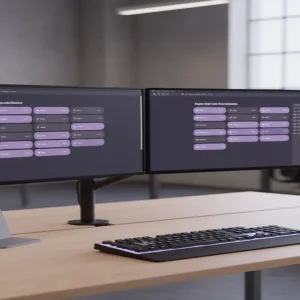
A Micro-Learning Blueprint is a hyper-specific, interactive workflow hosted on a platform like Notion. Unlike a course, which requires hours of video watching, a blueprint is a ‘plug-and-play’ system. Imagine a business owner who needs to hire their first virtual assistant. Instead of buying a course on ‘How to Hire,’ they buy your ‘VA Onboarding Blueprint.’ Inside, they find a ready-to-use job description, a Notion database for tracking applicants, a pre-made training checklist, and five Loom video templates for their new hire.
You aren’t selling them information; you are selling them an afternoon of their life back. These blueprints are designed to be consumed and implemented in under 60 minutes. The magic lies in the delivery. Because it’s built in Notion, the buyer can simply click ‘Duplicate’ and instantly have your entire system living inside their own workspace. It’s immediate, it’s frictionless, and for a busy founder, it’s worth ten times the price of a generic book.
Why B2B Micro-Learning Wins Every Time
Why focus on B2B (Business to Business) rather than B2C (Business to Consumer)? The answer is simple: business owners have budgets for efficiency, whereas individuals have ‘maybe later’ mentalities. When you solve a problem for a business, they don’t look at the price tag as a cost; they look at it as an investment. If your $150 blueprint saves a manager five hours of work, and their time is worth $100 an hour, you just gave them a $350 profit. It’s an easy ‘yes’ for them.
The best part? You don’t need a massive audience to make this work. While creators selling cheap products need thousands of clicks to make a living, you only need 20 sales a month to generate a consistent $3,000 in revenue. This high-margin, low-volume model allows you to focus on quality and deep transformation rather than the exhausting treadmill of viral content creation. You are building a boutique brand based on utility and results.
Your 5-Step Path to a $3,000/Month Revenue Stream
Step 1: Identify the ‘Bleeding Neck’ Problem
Don’t try to be everything to everyone. Look for a specific, recurring task that businesses struggle with. This could be anything from ‘Setting up a Content Calendar’ to ‘Onboarding New SaaS Clients’ or ‘Managing a Remote Sales Team.’ The more specific the problem, the higher the price you can command. Ask yourself: What is a task that takes people 4 hours but should take 30 minutes? That is your blueprint topic.
Step 2: Build the Implementation Skeleton in Notion
Open a fresh Notion page and build the workflow you would use yourself. Use databases to track progress, call-out blocks for ‘Pro-Tips,’ and synced blocks for navigation. Your goal is to make the page so intuitive that a user doesn’t need a manual to use it. Structure it chronologically: Phase 1 (Preparation), Phase 2 (Execution), Phase 3 (Review). The visual organization of the page is half the value.
Step 3: Layer in the ‘Actionable Assets’
This is where you differentiate from a basic template. Include ‘Actionable Assets’ like email scripts, Loom video walkthroughs (brief 2-minute clips), and copy-paste checklists. If you’re building a ‘Podcast Guesting Blueprint,’ include the exact outreach email that got you booked. Don’t just tell them what to do; give them the words to use. This ‘done-for-you’ element justifies the $150 price point.
Step 4: Set Up Your Gumroad Gateway
You don’t need a fancy website. Use Gumroad or LemonSqueezy to host your product. These platforms handle the payment processing, tax collection, and digital delivery automatically. When someone buys, they receive a PDF with a link to your Notion page and instructions on how to duplicate it. It takes less than 30 minutes to set up, and the fees are minimal compared to the value of the automation.
Step 5: The LinkedIn ‘Bridge’ Strategy
To get your first sales, don’t just post links. Use LinkedIn to share ‘The Process’ behind your blueprint. Write a post explaining the problem you solved and show a 30-second screen recording of your Notion setup. Offer a ‘Beta Price’ for the first 10 people who comment. This creates social proof and allows you to gather testimonials quickly. Direct message the interested parties, send them the link, and watch your first $150 notification pop up.
Realistic Earnings and Timelines
Let’s talk numbers. If you spend your first 7 days identifying a problem and building the blueprint, and the next 7 days promoting it on LinkedIn, you can realistically earn your first dollar within 14 days. A standard Micro-Learning Blueprint sells for $99 to $249. With a modest goal of 5 sales per week at a $150 price point, you are looking at $3,000 per month. As you build a library of 3-4 different blueprints, cross-selling to existing customers can easily push your revenue into the $5,000 to $8,000 range without increasing your workload.
Essential Tools for Your Blueprint Business
- Notion: The core platform for building and hosting your interactive blueprints.
- Gumroad: For seamless payment processing and automated product delivery.
- Loom: For recording short, high-value ‘how-to’ videos to embed in your Notion pages.
- LinkedIn: Your primary engine for reaching B2B decision-makers without paid ads.
- Canva: To create a professional-looking product thumbnail and LinkedIn graphics.
Common Pitfalls to Avoid
The biggest mistake beginners make is ‘Feature Creep.’ They try to add too many pages and too much information, which actually decreases the value. Remember, the client is paying for the *result*, not the length of the document. Keep it lean and focused on one specific outcome. If it takes them more than an hour to understand your system, it’s too complicated.
Another error is neglecting the ‘Why.’ Even though this is a utility tool, you still need to explain the logic behind your workflow. Use short 1-2 sentence intros for each section of your Notion page to explain why this step matters. Finally, don’t ignore your existing buyers. A business that buys one workflow from you is 5x more likely to buy a second one if you follow up with them via email.
Ready to Build Your First Asset?
The era of the ‘passive income ebook’ is over, but the era of the ‘implementation blueprint’ is just beginning. You already have a skill or a workflow that someone else is struggling to figure out. Why not package it and sell it to them? Your next step is simple: Open a blank Notion page today and map out the steps of a task you’ve already mastered. That simple page could be the start of your $3,000 monthly income stream.