The $2,000 Annual Tax You Can Turn Into Revenue
Did you know that the average person with ADHD spends over $2,000 every single year on the ‘ADHD Tax’—the literal cost of forgotten subscriptions, late fees, and lost items? It’s a staggering statistic that points to a massive, underserved market of professionals who are desperate for digital systems that actually work for their brains. While generic productivity gurus are busy selling ‘hustle’ planners, a new wave of digital architects is quietly making $4,000 to $6,000 a month by selling specialized Notion templates designed for neurodivergent minds.
📹 Watch the video above to learn more!
You don’t need to be a software engineer or a certified coach to tap into this. If you’ve ever built a system to manage your own chaos, you’re already sitting on a digital asset that people are willing to pay a premium for. Here’s the thing: people aren’t looking for another ‘to-do list’—they are looking for a dopamine-friendly external brain. Let me show you how to build it and, more importantly, how to sell it.
What is Neuro-Productivity Architecture?
Neuro-productivity architecture is the art of building digital workspaces—usually within a platform like Notion—that account for executive dysfunction. Unlike standard templates that focus on rigid schedules and complex databases, these ‘ADHD-friendly’ systems prioritize low-friction entry, visual cues, and dopamine-reward loops. It’s about creating a ‘Second Brain’ that doesn’t feel like a chore to maintain.
The Overwhelmed Economy
We are currently living in an ‘overwhelmed economy’ where the sheer volume of digital noise is breaking our focus. For neurodivergent individuals, this noise is deafening. This has created a massive demand for ‘pre-built peace of mind.’ When you sell a template, you aren’t selling software; you are selling the hours of time someone would have spent trying to organize their own life. You are selling the relief of a clear mind.
The Death of Generic Templates
The era of the ‘All-in-One Life Planner’ is fading because it’s too bloated for the average user. Modern buyers want hyper-specific solutions. They want a ‘Notion Dashboard for Neurodivergent Freelancers’ or a ‘Dopamine-Driven Student Hub.’ By narrowing your focus to a specific cognitive need, you eliminate your competition and can charge three times the price of a generic template.
Why This Niche is Exploding Right Now
The rise of ADHD awareness on platforms like TikTok and Instagram has led to a surge in people seeking specialized tools. However, most productivity software is still built for ‘linear’ thinkers. This gap between user need and software design is where your opportunity lies.
High Perceived Value
Because these templates solve a painful, daily problem—executive dysfunction—the perceived value is significantly higher than a standard calendar. Users view these tools as an investment in their mental health and career success, not just a digital download. This allows you to price your templates between $49 and $149, rather than the $5 to $10 range seen in the crowded ‘aesthetic’ planner market.
Low Maintenance, High Scalability
The best part? You build the architecture once. Once the logic is set and the databases are linked, your work is done. Every sale after the first is 100% profit, minus a small platform fee. Unlike freelancing, where you trade hours for dollars, your Notion engine works for you while you sleep, generating passive income through automated delivery systems like Gumroad.
Your 5-Step Blueprint to Launching
Ready to build your first high-ticket digital asset? Follow this specific sequence to go from zero to your first $1,000 month.
Step 1: Identify the Friction Point
Don’t try to organize someone’s entire life yet. Instead, focus on one specific ‘friction point.’ Is it managing a chaotic inbox? Is it tracking freelance invoices without losing them? Is it a grocery list that actually helps someone with sensory issues? Pick one problem and solve it deeply. Use Reddit’s r/ADHD or r/Notion to see what people are complaining about most.
Step 2: Build the ‘Low-Dopamine’ Interface
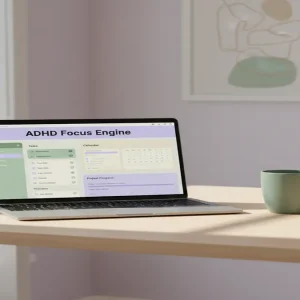
Open Notion and start building. The key to an ADHD-friendly template is ‘minimalism with a purpose.’ Use toggle lists to hide unnecessary information, create ‘Quick Capture’ buttons for fast entry, and use visual progress bars. Avoid ‘aesthetic’ clutter that creates visual noise. Your goal is to make the system feel ‘quiet’ and easy to use even when the user is having a low-energy day.
Step 3: Create the Loom Walkthrough
A template alone is just a skeleton. To make it a premium product, you need to provide the ‘nervous system.’ Record a 10-minute video using Loom explaining exactly how to use the system. Explain the ‘why’ behind your design choices. This video adds massive perceived value and reduces the number of customer support emails you’ll receive later.
Step 4: Setting Up Your Gumroad Storefront
Gumroad is the gold standard for this because it handles VAT, payment processing, and digital delivery automatically. Create a clean product page. Use Canva to create 3-4 high-quality mockups of your template on a laptop and tablet. Focus your product description on the *feeling* of being organized, not just a list of features.
Step 5: The ‘Organic Loop’ Marketing
You don’t need paid ads. Go to Pinterest and TikTok. Post a 15-second screen recording of your template in action with a trending sound. Show yourself ‘clearing the chaos’ in real-time. Link your Gumroad in your bio. This ‘show, don’t tell’ approach is the fastest way to build trust with a neurodivergent audience who is weary of over-complicated tools.
Realistic Earnings & Timelines
What can you actually expect to earn? If you price your template at $65 and sell just two per week, you’re looking at $520 a month in passive income. However, most successful creators in this niche scale much higher. By month three, with a library of three niche templates and a small social media presence, reaching $2,500 to $4,500 per month is a standard benchmark. Your first dollar usually arrives within 14-21 days of your first social media post.
Essential Tools for Your Business
- Notion: Your workspace for building the actual product (Free version is enough to start).
- Gumroad: For hosting your store and processing payments.
- Canva: For creating professional-looking product mockups and social media graphics.
- Loom: For recording the essential ‘How-to’ video tutorials for your customers.
- Pinterest: Your primary engine for long-term, organic traffic.
Common Mistakes to Avoid
- Over-Engineering: Don’t build a system that requires a PhD to understand. If it takes more than 5 minutes to learn, your customer will abandon it.
- Ignoring Mobile: Many users check their Notion on their phone. Ensure your ‘Quick Capture’ areas work perfectly on a small screen.
- Underpricing: Don’t compete with $5 Etsy planners. You are selling a specialized cognitive tool. Price it like one.
Your Next Step
Stop overthinking the ‘perfect’ business. Open a blank Notion page right now and build a simple ‘Daily Brain Dump’ system that you would personally use. That single page is the foundation of your first digital product. Once it’s built, head over to Gumroad and create your free account to start the journey toward your first $1,000 month.