The Low-Code Revolution You Are Currently Missing
Most people believe that owning a software company requires a computer science degree and a team of expensive developers in Silicon Valley. Here is the reality: a single-purpose Chrome extension, built without writing a single line of code, can be sold for $5,000 to $15,000 on digital marketplaces within months of its creation. You do not need to build the next Facebook; you just need to solve one tiny, annoying problem for a specific group of professionals.
📹 Watch the video above to learn more!
While everyone else is fighting over saturated markets like dropshipping or generic blogging, the browser extension space remains a massive, untapped frontier. Think about it: where do people spend 90% of their working hours? Inside a browser. When you own a piece of that real estate, you own the most valuable digital territory on the planet. Let me show you how to claim your stake.
What is the Micro-SaaS Extension Flip?
The concept is simple but incredibly powerful: you identify a repetitive task that people do in their browser and automate it with a simple tool. This is known as a “Micro-SaaS” (Software as a Service). Instead of a massive platform, you are building a “feature” that lives in the Chrome toolbar. Because these tools are so focused, they are incredibly easy to build using modern no-code builders.
Once the extension has a few hundred users and a small amount of recurring revenue, it becomes an “investable asset.” There is a massive secondary market of investors looking to buy small, profitable software tools. You aren’t just earning monthly subscription fees; you are building an asset that you can “flip” for 24x to 36x its monthly profit. If your extension makes $200 a month, it could be worth $5,000 to an investor today.
Why Browser Real Estate is More Valuable Than Websites
Traditional websites require users to remember a URL and navigate to a page, but a Chrome extension is always there, sitting right next to the address bar. This creates an insane level of user retention. Once someone installs your tool to help them manage their LinkedIn leads or format their Amazon product descriptions, they rarely uninstall it. It becomes part of their daily workflow.
The best part? The competition is remarkably low. While there are millions of Shopify stores and WordPress blogs, the Chrome Web Store is still relatively uncluttered. If you target a specific niche—like real estate agents, recruitment specialists, or SEO professionals—you can rank at the top of the store search results in a matter of days. This is organic traffic that you don’t have to pay a cent for.
Your 5-Step Blueprint to the First $5,000 Flip
1. Identifying the High-Value Friction Point
Do not guess what people want. Instead, go to forums like Reddit or specialized Facebook groups for niches like “High Ticket Sales” or “E-commerce Managers.” Look for people complaining about doing things manually. Are they copy-pasting data from one site to another? Are they struggling to calculate margins on the fly? That “annoyance” is your product idea. Your goal is to find a problem that takes 10 minutes to do manually and turn it into a 1-click solution.
2. Building Without a Single Line of Code
You don’t need to learn JavaScript. Use no-code platforms like Bubble.io or Builder.io. These platforms have dedicated templates and workflows specifically for Chrome extensions. You can literally drag and drop buttons, input fields, and logic flows. Focus on a single feature. If your extension does ten things, it’s too complicated. If it does one thing perfectly, it’s a winner.
3. Setting Up the Revenue Engine
To make your extension valuable to a buyer, it needs to generate money. Use a tool like ExtensionPay. It is a plug-and-play service that handles payments and licensing for Chrome extensions. You can set up a simple $9/month subscription. Even if you only get 50 users, that is $450 in monthly recurring revenue (MRR). In the world of software exits, that $450 MRR makes your extension a highly attractive acquisition target.
4. Growth via the “Niche Infiltration” Strategy
Once your extension is live on the Chrome Web Store, don’t just sit there. Go back to those forums where you found the problem and offer your tool for free to the first 20 people in exchange for a review. Positive reviews on the Web Store act as social proof and boost your search ranking. Once the reviews start rolling in, the Chrome Web Store’s own algorithm will start suggesting your tool to other users in that niche.
5. The Exit: Listing on Acquire.com
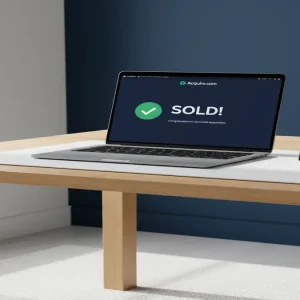
After 3 to 6 months of consistent revenue and user growth, it is time to get paid. List your extension on Acquire.com (formerly MicroAcquire). This is where thousands of investors go to buy small software businesses. Provide your revenue data and user growth charts. Because software has such high margins, extensions often sell for 3x their annual profit. A tool making $300/month can easily net you a $10,000 exit check.
Realistic Earnings and Timelines
Let’s talk numbers because transparency is key. For a beginner, the timeline from idea to first dollar is usually 30 to 45 days. Your initial investment will be roughly $25 for a Google Developer account and maybe $20/month for your no-code hosting. Your monthly earnings could realistically range from $200 to $1,500 depending on your niche. The real payday, however, is the exit. Flipping a micro-extension for $3,000 to $8,000 is a very achievable goal for your first project.
Essential Tools for Your Extension Business
- Bubble.io: The most robust no-code app builder for creating complex logic.
- ExtensionPay: The easiest way to take payments without building a custom backend.
- Acquire.com: The premier marketplace for selling your finished software asset.
- Canva: For creating professional-looking store icons and promotional screenshots.
- Loom: To create a simple demo video showing how your extension solves a problem.
Common Mistakes to Avoid
The biggest mistake is “Feature Creep.” Do not try to build a complex platform. If your tool takes more than a week to build, it’s too big. Keep it lean. Secondly, don’t ignore SEO for the Chrome Web Store. Use your target keywords in the title and the first two lines of your description. Finally, don’t wait for perfection. Launch a “Minimum Viable Product” (MVP), get feedback, and iterate based on what users actually want.
Your Next Move
The gap between where you are and your first software exit is smaller than you think. You don’t need a team; you just need a browser and a problem to solve. Here is your immediate next step: spend the next 60 minutes browsing a professional subreddit (like r/realtors or r/sales) and write down every time someone says “I wish there was a way to…” or “I’m tired of manually doing…”. That list is your roadmap to a $5,000 exit.