The Invisible Shift in the Digital Product Economy
While most creators are struggling to sell $10 checklists on Etsy, a quiet group of ‘Notion Architects’ is quietly banking thousands by solving high-level business problems. Here is the reality: the market is tired of surface-level digital products that don’t solve real-world friction. If you can build a system that saves a business owner five hours a week, they won’t just pay you $20; they will happily hand over $500 or more for a single license. Let me show you how to stop being a ‘template seller’ and start being a systems architect.
📹 Watch the video above to learn more!
Why Basic Templates Are Failing (And What to Build Instead)
Have you ever noticed how many ‘Daily Habit Trackers’ exist on the market? Thousands. The competition is fierce, the margins are razor-thin, and the customer loyalty is non-existent. To make real money in 2024, you need to pivot from ‘general’ to ‘operational.’ Instead of a habit tracker, imagine building a ‘Full-Stack Client Portal for Interior Designers’ or a ‘Litigation Pipeline for Small Law Firms.’ These aren’t just templates; they are business ecosystems that replace expensive, clunky software subscriptions.
The Architecture of a $500 Digital Asset
The secret to high-ticket pricing is perceived and actual value. When you package a Notion workspace with pre-configured databases, automated relations, and embedded video tutorials, you aren’t selling a document. You’re selling a turnkey business operation. Why would a consultant spend 40 hours building their own CRM when they can buy yours for $497 and be up and running in ten minutes? The best part? You build it once, and it sells forever with zero overhead.
The Step-by-Step Build: From Blank Page to Recurring Revenue
Step 1: Deep Niche Extraction
You can’t build for everyone. If you try to help ‘all business owners,’ you’ll end up helping nobody. You need to pick a niche that is already spending money on software but hates the complexity of it. Think about industries like property management, specialized coaching, or boutique creative agencies. Ask yourself: What is the one spreadsheet they are currently using that feels like a mess? That mess is your goldmine.
Step 2: Mapping the Workflow Friction
Before you open Notion, you need to map out the ‘User Journey.’ If you’re building for a real estate agent, what happens from the moment they get a lead to the moment they close the deal? You need to identify every touchpoint, every document needed, and every follow-up task. Your goal is to create a ‘Single Source of Truth’ where they can manage their entire professional life without clicking through twenty different tabs.
Step 3: Engineering the Solution in Notion
Now comes the fun part. You’ll use Notion’s advanced features—linked databases, formulas 2.0, and the new ‘Buttons’ feature—to create an automated experience. Use ‘Database Templates’ so that when your customer adds a new project, it automatically generates a pre-filled task list and a client-facing portal. This level of automation is what justifies the $500 price tag. It’s not just a page; it’s a machine.
Step 4: The Loom-Led Onboarding Experience
One of the biggest mistakes sellers make is leaving the customer to figure it out alone. To command high prices, you must include a ‘Video Vault.’ Use a tool like Loom to record short, 2-minute walkthroughs for every section of your ecosystem. This reduces your support tickets to almost zero and makes the customer feel like they have a personal consultant guiding them through the setup process.
Step 5: Launching on the Right Marketplaces
While you should eventually have your own site, you need to start where the traffic is. List your high-ticket ecosystem on Gumroad or LemonSqueezy, but don’t stop there. Reach out to niche-specific communities on LinkedIn or specialized Facebook groups. Show a ‘Before and After’ of a messy workflow versus your clean Notion system. The visual transformation is your strongest marketing tool.
Realistic Revenue: What Your Bank Account Actually Sees
Let’s talk numbers because that’s why you’re here. If you sell a specialized ‘Agency OS’ for $497, you only need 13 sales a month to hit $6,461 in gross revenue. In a world of 8 billion people, finding 13 people in a specific niche who need a better way to work is remarkably achievable. Unlike freelancing, you aren’t trading your hours for these dollars. Whether you sell 1 or 100, your workload remains exactly the same. Most architects see their first sale within 14 to 21 days of active outreach.
Your Essential Toolkit for Scaling
You don’t need a massive tech stack to run this business. In fact, keeping it lean is the best way to protect your profit margins. Here are the only tools you actually need to get started today:
- Notion: The core engine where you build your products (Free or Plus plan).
- Loom: For creating the essential video tutorials that justify your high price point.
- Gumroad: To handle payments, file delivery, and your affiliate program.
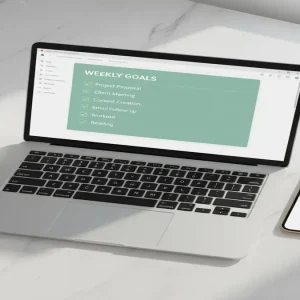
- Canva: To create professional-looking ‘Product Mockups’ that show your template inside a laptop screen.
- Typeform: To gather feedback from your early users so you can iterate and improve.
Common Traps That Kill Your Momentum
Don’t fall into the ‘Feature Creep’ trap. You might be tempted to add a hundred different pages to your template, but more isn’t always better. Your customers are paying for clarity, not clutter. If a page doesn’t directly help them reach their goal, delete it. Another mistake is underpricing. If you price your business system at $29, people will assume it’s low quality. Don’t be afraid to charge what the solution is worth to the business owner.
Your First Step Toward Architecture
The era of the $10 digital download is fading, but the era of the $500 business ecosystem is just beginning. You already have the skills to organize information; you just need to apply them to a high-value problem. Your next step is simple: Pick one niche today—just one—and list out the three biggest headaches they face in their daily operations. That list is the blueprint for your first $6,000 month. Are you ready to stop building pages and start building systems?