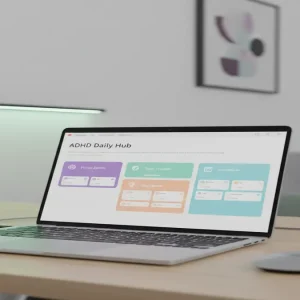
The Surprising Reason Your Generic Digital Products Aren’t Selling
Did you know that the productivity niche is the most crowded category on Etsy, yet 90% of sellers make less than $50 a month? It is a staggering statistic that scares most beginners away from the digital product space entirely. However, while the ‘general’ market is bleeding, a hyper-specific sub-niche is quietly generating $4,000 to $6,000 in monthly passive revenue for creators who understand one thing: neurodiversity. There are over 360 million adults worldwide living with ADHD, and most of them are desperate for tools that actually work for their unique brain chemistry. By pivoting from ‘daily planners’ to ‘executive dysfunction support tools,’ you aren’t just selling a PDF; you are selling a solution to a lifelong struggle.
📹 Watch the video above to learn more!
What Exactly is the ADHD Digital Planner Loophole?
The ADHD digital planner loophole is the practice of creating hyper-linked PDF documents designed specifically for use on tablets via apps like GoodNotes or Notability. Unlike standard planners that focus on rigid schedules and long-term goals, these ‘neuro-inclusive’ assets focus on dopamine-triggering layouts, gamified task completion, and sensory-friendly aesthetics. You aren’t competing with giant stationery brands; you are competing with a lack of specialized resources. This is a micro-business model where you create the asset once and sell it thousands of times to a community that is famously loyal to products that ‘finally make sense’ to them.
Why This Specific Niche is Exploding Right Now
The best part about this method is the psychological shift in the consumer. People with ADHD often struggle with ‘object permanence’—if they don’t see a task, it doesn’t exist. Digital planners allow for color-coding, moving tasks around without messy erasures, and integrating alarms. There is also a massive trend on platforms like TikTok and Instagram under hashtags like #ADHDhacks, where users showcase their ‘dopamine menus’ and ‘brain dump’ pages. By entering this market, you are tapping into a high-intent audience that is already searching for these specific terms but finding very few high-quality options.
The Benefits of Selling Neuro-Inclusive Assets
Why should you choose this over traditional freelancing or e-commerce? First, the overhead is nearly zero. You don’t need a warehouse, you don’t need to ship items, and you don’t need to handle returns of physical goods. Second, the profit margins are roughly 92-95% after marketplace fees. Third, and perhaps most importantly, this is a ‘set and forget’ income stream. Once your SEO is optimized on a platform like Etsy, the platform’s algorithm does the heavy lifting of finding your customers while you sleep.
How to Build Your $4K Digital Asset Empire
You don’t need to be a professional graphic designer to start this. You just need to understand the pain points of your target audience. Here is the exact blueprint to go from zero to your first $1,000 month.
Step 1: Research Executive Dysfunction Pain Points
Don’t guess what people want. Go to Reddit forums like r/ADHD or search ‘ADHD struggle’ on TikTok. You will find that people struggle with ‘task paralysis,’ ‘time blindness,’ and ‘forgetting to eat or drink water.’ Your planner should have specific pages dedicated to these issues, such as a ‘Dopamine Menu’ for motivation or a ‘Brain Dump’ section for late-night racing thoughts. Use these specific terms in your product titles.
Step 2: Design with ‘Dopamine-First’ Principles
Open Canva or Keynote. Instead of a boring black-and-white grid, use ‘sensory-friendly’ palettes like muted earth tones or soft pastels. Create ‘gamified’ habit trackers where the user gets a visual reward for checking off a box. Ensure your document is hyperlinked; this means when a user clicks the ‘July’ tab on the side of their iPad screen, it instantly jumps to that page. This reduces ‘friction,’ which is the enemy of the ADHD brain.
Step 3: The ‘Show, Don’t Tell’ Marketing Loop
You don’t need a huge ad budget. Create a ‘Study-with-me’ style video for Pinterest and TikTok. Show yourself (or just your hands) using the planner on an iPad. Highlight how easy it is to move a task from ‘today’ to ‘tomorrow’ without feeling guilty. These short-form videos act as a perpetual traffic machine for your Etsy shop. Focus on the transformation: from overwhelmed and chaotic to calm and organized.
Step 4: Master Etsy SEO for Neurodiversity
Forget the keyword ‘planner.’ Everyone is using that. Instead, target long-tail keywords like ‘digital planner for executive dysfunction,’ ‘ADHD student organizer,’ or ‘dopamine-friendly habit tracker.’ These keywords have lower competition and much higher conversion rates because the person searching for them knows exactly what they need.
Realistic Earnings and Timelines
Let’s talk numbers. A high-quality ADHD digital planner typically sells for $25 to $45. If you sell just three planners a day at a $35 price point, you are looking at $3,150 per month. Beginners can expect to earn their first dollar within 14 to 30 days of launching, provided their SEO is on point. Within 90 days, as you add more specialized ‘add-on’ packs (like a $10 ‘Meal Planner for Picky Eaters’), your average order value increases, making the $4,000/month goal very attainable.
Essential Tools for Your New Business
- Canva: For the initial layout and aesthetic design.
- Keynote (Mac) or PowerPoint (PC): The easiest tools for adding functional hyperlinks to your PDF.
- Etsy: The best marketplace to find your first 1,000 customers without spending on ads.
- Everbee: A specialized tool to see exactly which keywords your competitors are using to make sales.
- GoodNotes 6: To test your product and ensure all links work perfectly before uploading.
Common Mistakes to Avoid
The biggest mistake is ‘Feature Overload.’ People with ADHD get overwhelmed easily. If your planner has 500 pages of complex instructions, they won’t use it. Keep it simple and intuitive. Another mistake is ignoring mobile users; ensure your design looks good on both a large iPad and a smaller tablet. Finally, don’t forget to include a ‘Quick Start Guide’ PDF with every purchase. If they can’t figure out how to import the file into their app within 60 seconds, they will leave a negative review.
Your Next Step to Passive Income
The gap between where you are and a $4,000 monthly income is simply a lack of specific digital assets. Stop trying to sell to everyone and start solving a deep, personal problem for a specific community. Your next step is simple: Open a free Canva account today and design just ONE ‘Brain Dump’ page to see how it feels. The market is waiting for a tool that finally works for them—will you be the one to create it?