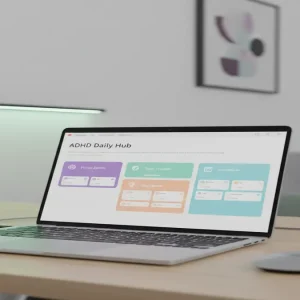
The Invisible Market for Executive Function Support
Did you know that neurodivergent professionals are currently the fastest-growing segment of the digital productivity market, yet 90% of organization tools are built for neurotypical brains? You’re likely sitting on a massive opportunity if you can bridge the gap between standard organization and specific executive function support. I’ve watched creators go from zero to $4,500 in monthly revenue by stopping the pursuit of ‘everyone’ and focusing exclusively on the unique needs of the ADHD brain.
📹 Watch the video above to learn more!
The reality is that for millions of people, a standard to-do list is actually a source of anxiety rather than a tool for success. When you create a digital product that understands the ‘Wall of Awful’ or the need for dopamine-driven rewards, you aren’t just selling a template; you’re selling a functional external brain. This is why specialized Notion templates are currently outperforming generic planners by a factor of five to one in the current digital marketplace.
What Exactly is a Neuro-Inclusive Digital Asset?
A neuro-inclusive Notion template is a pre-configured workspace designed specifically to accommodate executive dysfunction, time blindness, and sensory overwhelm. Unlike standard templates that focus on rigid schedules and complex hierarchies, these tools prioritize low-friction entry and visual clarity. You’re building a system where a user can ‘dump’ their thoughts into a database with a single click, or view their week through a color-coded energy tracker rather than a traditional clock.
Think of it as the difference between a blank notebook and a guided journal designed by a cognitive specialist. The value lies in the architecture of the Notion database. You use advanced features like formulas, buttons, and filtered views to automate the boring parts of organization that usually cause an ADHD brain to disengage. Because Notion is a ‘low-code’ platform, you can build these sophisticated systems without knowing how to write a single line of traditional software code.
Why This Specific Niche is Currently Exploding
The Psychology of the High-Value Sale
People with ADHD are often desperate for solutions that actually work for their specific cognitive profile. When they find a tool that uses ‘dopamine-first’ design—such as progress bars that fill up with vibrant colors or automated ‘celebrations’ for completing tasks—the perceived value skyrockets. You aren’t competing on price with a $5 generic planner; you’re offering a specialized solution that people are happy to pay $35 to $65 for because it solves a deep, daily pain point.
Low Competition and High Customer Loyalty
While the ‘productivity’ niche is oversaturated, the ‘neuro-inclusive’ niche is still in its infancy. Most big-box software companies cannot pivot fast enough to address these specific needs. As a solo creator, you can engage directly with communities on Reddit or TikTok to learn exactly what features they are missing. Once a neurodivergent user finds a system that doesn’t make them feel like a failure, they become your most loyal brand ambassadors, often sharing your work across social media without you spending a dime on ads.
How to Build Your Template Empire from Scratch
Step 1: Deep-Dive into Executive Dysfunction Pain Points
Your first step isn’t opening Notion; it’s opening a research document. Spend three days in subreddits like r/ADHD or r/Notion and look for the phrase ‘I wish I could…’ or ‘Why is it so hard to…’ You’ll find that ‘Time Blindness’ and ‘Task Paralysis’ are the two biggest hurdles. Your template must address these specifically. For example, you might create a ‘Quick Capture’ button that lives on the phone’s home screen, allowing users to record ideas before they forget them, without having to navigate a complex menu.
Step 2: Master the ‘Dopamine-Driven’ Logic
Now you can start building in Notion. Focus on creating ‘Dopamine Menus’—lists of quick, high-reward activities users can do when they feel stuck. Use Notion’s new ‘Button’ feature to create one-click workflows. For instance, a button labeled ‘I’m Overwhelmed’ could automatically hide all non-essential tasks and show only the one most important item. This level of ‘logic-based’ design is what separates a $4,500-a-month shop from a hobbyist who makes a few dollars here and there.
Step 3: Visual Hierarchy and Sensory Design
Aesthetics matter more in this niche than anywhere else. Too much white space can be under-stimulating, while too many icons can be overwhelming. Use high-quality, custom-made cover images and icons created in Canva. Stick to a ‘Soft Minimalist’ or ‘Dark Mode’ aesthetic to reduce visual fatigue. Ensure that the most important information is always the most visually prominent. You want the user to feel calm the moment they open their dashboard.
Step 4: The ‘Boring’ Part: Testing and Debugging
Before you list your product, you must stress-test it. Give it to three people for free and watch them use it. Do they get lost? Do the database relations break? A broken template is the fastest way to get a one-star review on Etsy, which can kill your shop before it starts. Make sure your ‘onboarding’ is seamless. Include a video walkthrough showing them exactly how to duplicate the template and customize it for their own life.
Step 5: Strategic Launch on Etsy and Gumroad
Don’t just upload and hope. Use a tool like Everbee or eRank to find long-tail keywords. Instead of just ‘Notion Template,’ use ‘ADHD Student Planner Notion’ or ‘Executive Function Dashboard.’ List your product on Etsy for the organic traffic and on Gumroad for your social media links. Create 15-second TikToks or Reels showing a ‘Before and After’ of a cluttered brain versus your organized template. This visual proof is your most powerful marketing weapon.
What Can You Actually Expect to Earn?
Let’s talk real numbers. A high-quality, niche Notion template typically sells for $25 to $45. In your first month, while you’re building your SEO presence, you might see 5 to 10 sales ($125 – $450). By month three, once your Etsy listings start ranking and you’ve posted a few viral videos, hitting 50 sales a month is very realistic ($1,250 – $2,250). By month six, successful creators in this space often have 3 to 5 different templates in their shop, leading to a consistent $4,000 to $5,000 in monthly revenue with nearly 95% profit margins.
The Essential Toolkit for Success
- Notion: The core platform (The free version is enough to start, but the Plus plan is better for sharing).
- Canva: For creating your listing images, icons, and custom covers.
- Etsy: Your primary marketplace for organic search traffic.
- Loom: For recording the 5-minute tutorial videos that you’ll include with every purchase.
- Everbee: To spy on high-performing keywords and see what’s actually selling in real-time.
Common Pitfalls That Kill Your Progress
The biggest mistake is ‘The Feature Trap.’ You think that adding more databases and more pages makes the template more valuable. In the neurodivergent niche, the opposite is true. Complexity is the enemy. If it takes more than three clicks to find a piece of information, your user will abandon the tool. Keep it lean and keep it fast.
Another fatal flaw is ignoring the mobile experience. Many users will interact with your template on their phones while they are on the go. If your beautiful dashboard looks like a mess on a small screen, you’ll get refund requests. Always design with a ‘Mobile-First’ mindset, ensuring your buttons and databases stack correctly on the Notion mobile app.
Your Next Step to Digital Freedom
The gap in the market is clear, and the tools are free. Your only task now is to choose one specific neurodivergent struggle—like ‘The Sunday Scaries’ or ‘Project Paralysis’—and build a simple, 3-page Notion solution for it. Don’t wait for it to be perfect. Build the ‘Minimum Viable Product’ and get it in front of people who need it. Your first sale is waiting for you in the comments section of a productivity forum; you just have to build the bridge to get there.