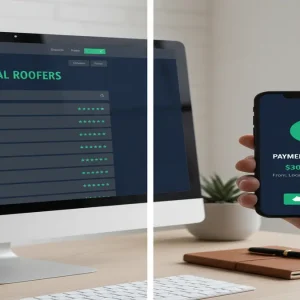
The Myth of the ‘Big Startup’ and the Rise of the Solo Micro-SaaS
Did you know that 92% of software startups fail within three years because they try to solve too many problems at once? While the world is obsessed with building the next ‘everything app,’ a quiet group of solo creators is making $3,500 to $8,000 per month by building apps that do exactly one thing very well. The best part? They aren’t writing a single line of code, and they aren’t working 80-hour weeks.
📹 Watch the video above to learn more!
If you’ve ever felt like you missed the boat on the software boom because you aren’t a developer, here’s the thing: the ‘no-code’ revolution has leveled the playing field. We are currently in a gold rush where ‘boring’ problems in specific industries are waiting for simple, automated solutions. Let me show you how to identify these gaps and build a digital asset that pays you while you sleep.
What Exactly is a ‘Single-Feature’ Micro-SaaS?
A Micro-SaaS (Software as a Service) is a software business targeting a niche market, run by one person or a tiny team, with minimal costs. Unlike traditional software that tries to be a Swiss Army knife, a single-feature app is like a high-quality screwdriver. It solves one specific friction point for a specific group of people—think of a tool that only generates PDF invoices for freelance dog walkers, or a simple dashboard that tracks expiration dates for chemical laboratory supplies.
By narrowing your focus, you eliminate the complexity that kills most businesses. You don’t need a massive server infrastructure or a team of UI/UX designers. You just need a platform like Bubble.io or FlutterFlow to drag and drop your way to a functional product. Because the scope is so small, you can go from an idea to a paying customer in less than 30 days.
Why This Method Beats Every Other Side Hustle
High Profit Margins and Low Overhead
Unlike e-commerce, you have no physical inventory, no shipping costs, and no manufacturing delays. Your only real ‘cost of goods sold’ is the monthly subscription to your no-code builder and your database, which usually totals less than $100. When you sell a subscription for $29/month, almost all of that is pure profit.
Predictable Recurring Revenue
Freelancing is a treadmill; if you stop running, the money stops. With a Micro-SaaS, you’re building compounding income. Every new user you acquire adds to your Monthly Recurring Revenue (MRR). Once the tool is built, your primary job is simple maintenance and occasional support, allowing you to scale your income without scaling your hours.
The Exit Potential
The most overlooked benefit is that software is an asset. Platforms like Acquire.com or Empire Flippers allow you to sell your Micro-SaaS for 3x to 5x your annual profit. A tool making $3,000 a month could potentially be sold for a lump sum of $100,000 or more, providing a life-changing exit from a project you built in your spare time.
How to Get Started: Your 5-Step Blueprint
Step 1: Hunt for ‘Friction Points’ in Boring Niches
Stop looking for ‘cool’ ideas and start looking for ‘painful’ ones. Go to industry-specific forums on Reddit or specialized Facebook groups for professions like HVAC contractors, property managers, or boutique gym owners. Look for people complaining about using Excel for something that feels like it should be automated. When you see someone say, ‘I wish there was a simple way to…’, you’ve found your goldmine.
Step 2: The ‘No-Code’ Build Phase
Once you’ve identified the problem, use a tool like Bubble.io. It allows you to build complex logic and databases visually. Focus only on the core feature. If your app helps real estate agents calculate commissions, don’t add a CRM, a calendar, and a chat function. Just build the best commission calculator they’ve ever seen. This is your Minimum Viable Product (MVP).
Step 3: Set Up the Subscription Engine
Integration is key. Use Stripe to handle your payments. It connects seamlessly with most no-code platforms. Instead of a complex pricing tier, start with one simple monthly price (e.g., $19/month). This reduces ‘choice paralysis’ for your first users and makes your initial marketing much cleaner.
Step 4: The ‘Un-Scalable’ Growth Phase
Don’t run expensive ads yet. Reach out directly to the people you found in Step 1. Offer them a ‘Founding Member’ discount or a 30-day free trial in exchange for feedback. Your goal is to get 10-20 users who absolutely love the tool. Their testimonials will be the fuel for your actual launch on platforms like Product Hunt or Indie Hackers.
Step 5: Automate and Step Back
As users join, use Tally.so for feedback forms and Crisp.chat for automated customer support. Once the bugs are ironed out and the feature is stable, your main task is content marketing or SEO to keep a steady stream of new users coming in. At this point, the business is 90% passive.
Realistic Earnings Potential
Let’s talk numbers. This isn’t a ‘get rich overnight’ scheme, but the math is incredibly favorable. If you charge $25 per month—a very reasonable price for a B2B tool—you only need 140 customers to reach $3,500/month. In a world of 8 billion people, finding 140 people in a specific niche who have a specific problem is highly achievable. Most successful Micro-SaaS creators reach their first $1,000/month within 3 to 6 months and hit the $3,000+ mark within a year.
Required Tools and Resources
- Bubble.io: The most powerful no-code app builder for web applications.
- Stripe: For handling global payments and subscriptions safely.
- Carrd: For building a simple, high-converting landing page to capture leads.
- Loom: For creating quick video tutorials to show users how your tool works.
- Acquire.com: To research what kind of apps are currently selling for the most money.
Common Mistakes to Avoid
Over-Engineering the Product: The biggest killer of Micro-SaaS is ‘feature creep.’ You do not need a mobile app, a dark mode, and 50 integrations on day one. Stick to the one feature that solves the pain. If you try to build everything, you’ll end up launching nothing.
Ignoring the Niche: Don’t build a ‘general’ productivity tool. You can’t compete with Notion or Slack. Build a productivity tool specifically for underwater welders. The more specific the niche, the less competition you have and the more you can charge.
Fear of Charging: Many beginners offer their tool for free indefinitely. This is a mistake. If your tool provides value, people will pay for it. Charging money is the ultimate form of validation; if no one will pay $10 for it, you haven’t solved a big enough problem.
Your Next Move
The era of needing a computer science degree to build a software empire is over. Your competitive advantage isn’t your ability to code; it’s your ability to spot a problem and package a solution. Your clear next step is this: Spend 30 minutes today browsing the ‘Small Business’ or ‘Entrepreneur’ subreddits and look for three recurring complaints. That is where your $3,500/month journey begins.