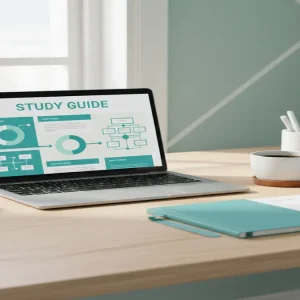
The Invisible Market for Student Success
Most people think the education market is dominated by massive publishers, but the truth is that thousands of individual creators are quietly earning four figures a month selling simplified study guides. You don’t need a PhD or a teaching degree; you just need to be able to distill complex information into digestible, aesthetically pleasing visual summaries.
📹 Watch the video above to learn more!
By creating high-value ‘cheat sheets’ and summarized lecture notes for specific university-level courses, you are solving an immediate, painful problem for students who are drowning in information. This is a high-demand, low-friction digital product business that requires zero inventory and carries a massive profit margin.
What Exactly Is a Digital Study Guide Business?
This business model involves creating condensed, highly structured study materials—such as mind maps, concept tables, and mnemonic-heavy summaries—and selling them as instant-download PDFs. Unlike traditional tutoring, where you trade hours for dollars, these guides are created once and sold thousands of times.
You are essentially packaging ‘clarity’ for students who are willing to pay a premium to save time before an exam. Whether it is Organic Chemistry, Macroeconomics, or Constitutional Law, if a subject is difficult, there is a market for your synthesis of that topic.
Why This Strategy Outperforms Traditional Freelancing
The beauty of this model lies in its scalability. When you freelance, your income is capped by the number of hours in your day. When you sell digital study guides, your income is decoupled from your time.
Students are desperate for resources that cut through the fluff of 500-page textbooks. Once you upload your file to a marketplace, it becomes a digital asset that works for you 24/7, across time zones, without you ever needing to handle shipping or customer service.
How to Launch Your Study Guide Empire
Getting started doesn’t require complex coding or deep technical skills. You simply need a process that turns raw information into a polished final product.
Step 1: Identify Your Niche
Don’t try to cover every subject. Pick one or two ‘bottleneck’ courses—the classes that are known for having high failure rates or overwhelming syllabi. Search on platforms like Reddit or university forums to see which subjects students are complaining about most.
Step 2: Curate and Condense
Take your notes or source materials and strip away the filler. Focus on the core concepts, common exam questions, and difficult formulas. Use a clean, modern design—students are more likely to purchase a guide that looks professional and is easy to read.
Step 3: Leverage Design Tools
Use platforms like Canva or Notion to build your documents. Canva offers excellent templates for infographics, while Notion is perfect for creating structured, searchable databases of information that students can use to review content on the go.
Step 4: Choose Your Marketplace
Start by uploading your products to Stuvia or Nexus Notes. These platforms are specifically designed for students to buy and sell study materials. They already have the traffic, meaning you don’t need to spend thousands on ads to get your first sale.
Earnings Potential and Realism
If you execute this well, you can realistically expect to earn between $500 and $4,000 per month. The timeline to your first dollar is surprisingly short—often within 14 to 30 days if you target a high-demand course before exam season.
The initial investment is effectively zero, provided you already have a laptop and internet access. The only real cost is the time spent researching and formatting your guides, which typically takes 10 to 15 hours for a comprehensive set of notes.
Essential Tools to Get You Started
- Canva: For creating visually stunning infographics and charts.
- Notion: For organizing complex academic data into clean tables.
- Stuvia: Your primary marketplace for reaching students.
- Grammarly: To ensure your notes are professional and error-free.
Common Mistakes to Avoid
First, don’t violate copyright laws. Always create original summaries; never copy-paste copyrighted textbook content or professor slides directly. Second, don’t ignore the ‘preview’ feature. Always provide a high-quality snippet of your work so buyers know exactly what they are getting.
Finally, avoid ‘wide’ topics. A guide on ‘General Biology’ will sell worse than a guide on ‘The Krebs Cycle for Biochemistry Students.’ Specificity sells because it solves a specific, acute problem for the buyer.
The Path Forward
You have the ability to turn academic knowledge into a recurring income stream. The students are already searching for the help you can provide, and the platforms are ready to host your work. Start by picking one difficult subject you understand well, condense it into a beautiful 10-page guide, and upload it to a marketplace this weekend. Your first sale is waiting.